Understanding a 33kV Voltage Transformer (VT) – Features, Functions, and Importance in Power Systems
Voltage Transformers (VTs), also known as Potential Transformers (PTs), play a vital role in medium and high-voltage electrical systems.
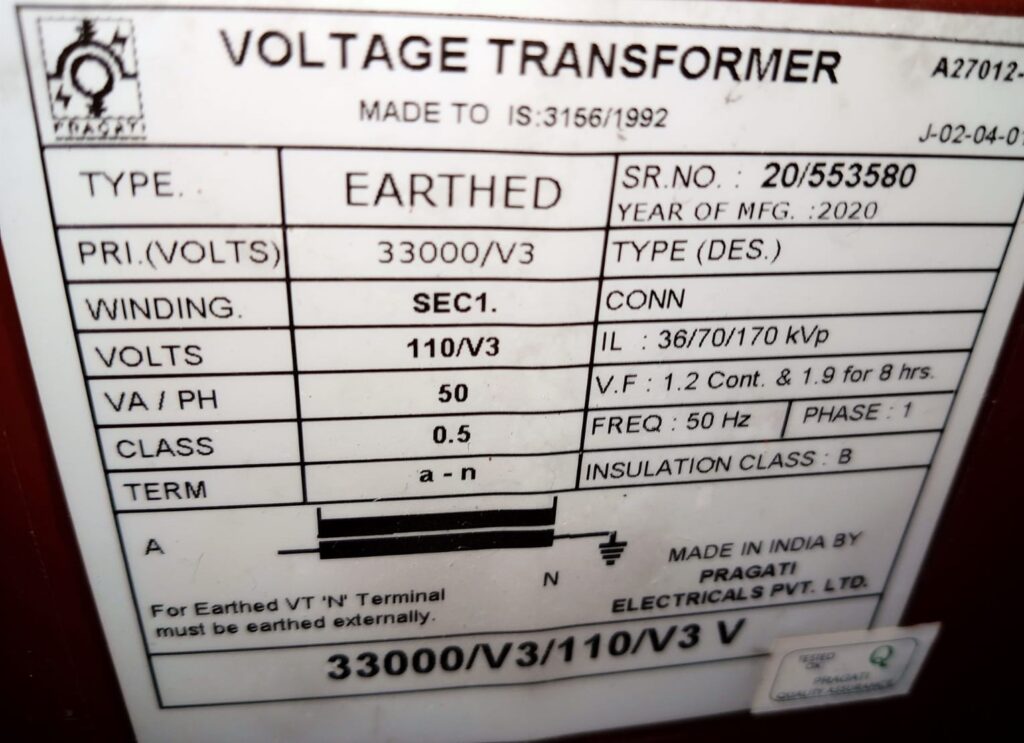
They are essential for accurate voltage measurement, protection, and safe operation of electrical networks. In this article, we will explore the specifications and applications of a 33kV Earthing Type Voltage Transformer, similar to the unit shown above.
What is a Voltage Transformer?
A Voltage Transformer is an instrument transformer designed to step down high voltages to safer and measurable levels. This allows measuring instruments, protection relays, and monitoring systems to operate safely without being directly exposed to high voltage.
The main purpose of a VT includes:-
Voltage measurement
Protection relay operation
System monitoring and control
Electrical isolation between high voltage and control systems
Key Specifications of the Voltage Transformer
The Voltage Transformer contains several important technical details that define its operation and performance.
- Rated Voltage
Primary Voltage: 33,000 / √3 V
Secondary Voltage: 110 / √3 V
This means the transformer converts the medium voltage level of 33kV into a standard measurable voltage of 110V for instruments and relays. - Type – Earthed Voltage Transformer
This VT is an earthed type transformer, meaning:
One terminal of the secondary winding is connected to earth.
Provides improved system safety.
Helps detect earth faults in power systems.
The label also clearly states that the neutral terminal must be externally earthed, which is critical for safe and correct operation. - Accuracy Class
Class: 0.5
Accuracy class indicates how precise the voltage measurement is. A Class 0.5 VT means the measurement error remains within ±0.5%, making it suitable for metering and monitoring applications. - Burden Rating
VA per Phase: 50 VA
Burden rating indicates the load that can be connected to the secondary winding without affecting accuracy. This transformer can safely supply 50 VA per phase to connected instruments. - Insulation Level
Insulation Level: 36/70/170 kVp
This indicates the transformer’s ability to withstand:
Power frequency voltage
Lightning impulse voltage
Switching surge voltage
These ratings ensure reliable operation under high voltage stress and transient conditions. - Voltage Factor (V.F.)
1.2 Continuous
1.9 for 8 Hours
Voltage factor shows how much overvoltage the transformer can withstand without damage. This VT can operate continuously at 120% voltage and temporarily handle 190% voltage during system faults. - Operating Frequency and Phase
Frequency: 50 Hz
Phase: Single Phase
This matches standard power system frequency used in countries like Sri Lanka and India. - Insulation Class
Class B
Insulation Class B allows safe operation up to approximately 130°C winding temperature, ensuring thermal durability and longer service life.
Applications of 33kV Voltage Transformers
Voltage Transformers of this type are widely used in:-
Medium voltage substations
Power distribution networks
Switchgear panels
Protection relay systems
Energy metering systems
Fault detection and monitoring
They are especially critical in ensuring protection relays operate correctly during abnormal conditions such as overvoltage or earth faults.
Importance of Proper Earthing
The diagram and note on the transformer highlight that the neutral terminal must be externally earthed.
Proper earthing:-
Enhances system safety
Stabilizes voltage references
Improves fault detection
Prevents equipment damage
Improper earthing can lead to inaccurate readings and serious safety hazards.
Manufacturer and Compliance
This Voltage Transformer is manufactured according to IS 3156:1992, which is a recognized Indian Standard for instrument transformers. Compliance with such standards ensures reliability, safety, and performance consistency
Maintenance and Safety Considerations
To ensure long-term reliability, the following maintenance practices are recommended:-
Regular insulation resistance testing
Visual inspection for oil leaks or physical damage
Verification of earthing connections
Monitoring of secondary load burden
Periodic calibration checks
Conclusion
A 33kV Earthed Voltage Transformer is a crucial component in medium voltage power systems. By stepping down high voltages safely and accurately, it enables reliable measurement, protection, and monitoring of electrical networks. Understanding its specifications helps engineers and technicians ensure proper installation, operation, and maintenance for long-term system reliability.
About the Author